
Started his career from nowhere to here is really remarkable. Pankaj Tripathi is an indian actor famously known as "Kaleen Bhaiya" from Mirzapur series. He is one of the finest actors in indian cinema who has impacted a larger audience.
Sunday, 5 September 2021
Friday, 30 August 2019
I DON'T KNOW
"Do what?" you ask. I DON'T KNOW. LET'S FIGURE THAT OUT TOGETHER.
Feel free to stop reading this if your career is going great, you're thrilled with your life, and you're happy with your relationships. Enjoy the rest of your day, friend, this article is not for you. You're doing a great job, we're all proud of you. So you don't feel like you wasted your click,
For the rest of you, I want you to try something: Name five impressive things about yourself. Write them down or just shout them out loud to the room. But here's the catch -- you're not allowed to list anything you are (i.e., I'm a nice guy, I'm honest), but instead can only list things that you do (i.e., I just won a national chess tournament, I make the best chili in Massachusetts). If you found that difficult, well, this is for you, and you are going to hate hearing it.
So let's start....
So let's start....
#6. The World Only Cares About What It Can Get from You

Let's say that the person you love the most has just been shot. He or she is lying in the street, bleeding and screaming. A guy rushes up and says, "Step aside." He looks over your loved one's bullet wound and pulls out a pocket knife -- he's going to operate right there in the street.

You ask, "Are you a doctor?"
The guy says, "No."
You say, "But you know what you're doing, right? You're an old Army medic, or ..."
At this point the guy becomes annoyed. He tells you that he is a nice guy, he is honest, he is always on time. He tells you that he is a great son to his mother and has a rich life full of fulfilling hobbies, and he boasts that he never uses foul language.
Confused, you say, "How does any of that fucking matter when my [wife/husband/best friend/parent] is lying here bleeding! I need somebody who knows how to operate on bullet wounds! Can you do that or not?!?"
Now the man becomes agitated -- why are you being shallow and selfish? Do you not care about any of his other good qualities? Didn't you just hear him say that he always remembers his girlfriend's birthday? In light of all of the good things he does, does it really matter if he knows how to perform surgery?
In that panicked moment, you will take your bloody hands and shake him by the shoulders, screaming, "Yes, I'm saying that none of that other shit matters, because in this specific situation, I just need somebody who can stop the bleeding, you crazy fucking asshole."

So here is my terrible truth about the adult world: You are in that very situation every single day. Only you are the confused guy with the pocket knife. All of society is the bleeding gunshot victim.
If you want to know why society seems to shun you, or why you seem to get no respect, it's because society is full of people who need things. They need houses built, they need food to eat, they need entertainment, they need fulfilling sexual relationships. You arrived at the scene of that emergency, holding your pocket knife, by virtue of your birth -- the moment you came into the world, you became part of a system designed purely to see to people's needs.

Either you will go about the task of seeing to those needs by learning a unique set of skills, or the world will reject you, no matter how kind, giving, and polite you are. You will be poor, you will be alone, you will be left out in the cold.
Does that seem mean, or crass, or materialistic? What about love and kindness -- don't those things matter? Of course. As long as they result in you doing things for people that they can't get elsewhere. For you see ...
#5. The Hippies Were Wrong
 Getty
Getty
Here is the greatest scene in the history of movies (WARNING: EXTREME NSFW LANGUAGE):
For those of you who can't watch videos, it's the famous speech Alec Baldwin gives in the cinematic masterpiece Glengarry Glenn Ross. Baldwin's character -- whom you assume is the villain -- addresses a room full of dudes and tears them a new asshole, telling them that they're all about to be fired unless they "close" the sales they've been assigned:
"Nice guy? I don't give a shit. Good father? Fuck you! Go home and play with your kids. If you want to work here, close."
It's brutal, rude, and borderline sociopathic, and also it is an honest and accurate expression of what the world is going to expect from you. The difference is that, in the real world, people consider it so wrong to talk to you that way that they've decided it's better to simply let you keep failing.

"First graders, welcome to Mr. Baldwin's third period art class -- is everyone here? Well, I'm goin' anyway."
That scene changed my life. I'd program my alarm clock to play it for me every morning if I knew how. Alec Baldwin was nominated for an Oscar for that movie and that's the only scene he's in. As smarter people have pointed out, the genius of that speech is that half of the people who watch it think that the point of the scene is "Wow, what must it be like to have such an asshole boss?" and the other half think, "Fuck yes, let's go out and sell some goddamned real estate!"
That scene changed my life. I'd program my alarm clock to play it for me every morning if I knew how. Alec Baldwin was nominated for an Oscar for that movie and that's the only scene he's in. As smarter people have pointed out, the genius of that speech is that half of the people who watch it think that the point of the scene is "Wow, what must it be like to have such an asshole boss?" and the other half think, "Fuck yes, let's go out and sell some goddamned real estate!"
"If you were in that room, some of you would understand this as a work, but feed off the energy of the message anyway, welcome the coach's cursing at you, 'this guy is awesome!'; while some of you would take it personally, this guy is a jerk, you have no right to talk to me like that, or -- the standard maneuver when narcissism is confronted with a greater power -- quietly seethe and fantasize about finding information that will out him as a hypocrite. So satisfying."
 Getty
Getty"I swear, if he mentions my hair, I'll slap his face so har- Yes, sir, I'm listening. I'm sorry."
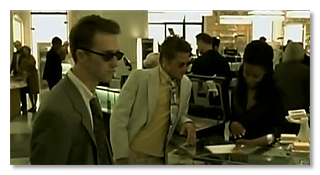
That excerpt is from an insightful critique of "hipsters" and why they seem to have so much trouble getting jobs (that doesn't begin to do it justice, go read the whole thing), and the point is that the difference in those two attitudes -- bitter vs. motivated -- largely determines whether or not you'll succeed in the world. For instance, some people want to respond to that speech with Tyler Durden's line from Fight Club: "You are not your job."
But, well, actually, you totally are. Granted, your "job" and your means of employment might not be the same thing, but in both cases you are nothing more than the sum total of your useful skills. For instance, being a good mother is a job that requires a skill. It's something a person can do that is useful to other members of society. But make no mistake: Your "job" -- the useful thing you do for other people -- is all you are.
There is a reason why surgeons get more respect than comedy writers. There is a reason mechanics get more respect than unemployed hipsters. There is a reason your job will become your label if your death makes the news ("NFL Linebacker Dies in Murder/Suicide"). Tyler said, "You are not your job," but he also founded and ran a successful soap company and became the head of an international social and political movement. He was totally his job.
 Getty
GettyIt was the irony that many people missed from that movie.
Or think of it this way: Remember when Chick-fil-A came out against gay marriage? And how despite the protests, the company continues to sell millions of sandwiches every day? It's not because the country agrees with them; it's because they do their job of making delicious sandwiches well. And that's all that matters.
You don't have to like it. I don't like it when it rains on my birthday. It rains anyway. Clouds form and precipitation happens. People have needs and thus assign value to the people who meet them. These are simple mechanisms of the universe and they do not respond to our wishes.
 Getty
Getty"This is bullshit. I have a completely clean criminal record, and this is the thanks I get?"
If you protest that you're not a shallow capitalist materialist and that you disagree that money is everything, I can only say: Who said anything about money? You're missing the larger point.
#4. What You Produce Does Not Have to Make Money, But It Does Have to Benefit People
 Getty
Getty
Let's try a non-money example so you don't get hung up on that. The demographic that Cracked writes for is heavy on 20-something males. So on our message boards and in my many inboxes I read several dozen stories a year from miserable, lonely guys who insist that women won't come near them despite the fact that they are just the nicest guys in the world. I can explain what is wrong with this mindset, but it would probably be better if I let Alec Baldwin explain it:
In this case, Baldwin is playing the part of the attractive women in your life. They won't put it as bluntly as he does -- society has trained us not to be this honest with people -- but the equation is the same. "Nice guy? Who gives a shit? If you want to work here, close."
So, what do you bring to the table? Because the Zooey Deschanel lookalike in the bookstore that you've been daydreaming about moisturizes her face for an hour every night and feels guilty when she eats anything other than salad for lunch. She's going to be a surgeon in 10 years. What do you do?
 Getty
Getty"Well, I'm fucking wicked at capture the flag."
"What, so you're saying that I can't get girls like that unless I have a nice job and make lots of money?"
No, your brain jumps to that conclusion so you have an excuse to write off everyone who rejects you by thinking that they're just being shallow and selfish. I'm asking what do you offer? Are you smart? Funny? Interesting? Talented? Ambitious? Creative? OK, now what do you do to demonstrate those attributes to the world? Don't say that you're a nice guy -- that's the bare minimum. Pretty girls have guys being nice to them 36 times a day. The patient is bleeding in the street. Do you know how to operate or not?
"Well, I'm not sexist or racist or greedy or shallow or abusive! Not like those other douchebags!"
I'm sorry, I know that this is hard to hear, but if all you can do is list a bunch of faults you don't have, then back the fuck away from the patient. There's a witty, handsome guy with a promising career ready to step in and operate.
 Getty
Getty"Wait, I said I wouldn't hit you!"
Does that break your heart? OK, so now what? Are you going to mope about it, or are you going to learn how to do surgery? It's up to you, but don't complain about how girls fall for jerks; they fall for those jerks because those jerks have other things they can offer. "But I'm a great listener!" Are you? Because you're willing to sit quietly in exchange for the chance to be in the proximity of a pretty girl (and spend every second imagining how soft her skin must be)? Well guess what, there's another guy in her life who also knows how to do that, and he can play the guitar. Saying that you're a nice guy is like a restaurant whose only selling point is that the food doesn't make you sick. You're like a new movie whose title is This Movie Is in English, and its tagline is "The actors are clearly visible."
I think this is why you can be a "nice guy" and still feel terrible about yourself. Specifically ...
Sunday, 19 August 2018
General Knowledge: Most Important Questions (Part-I)
The bold options are the Correct Answers...
Q1. Who was the first secretary general of All India Muslim League?
- Hassan Bilgrami
- Nawab Mohsan Ul Mulk
- Nawab Waqar Ul Mulk
- Nawab Saleem Ullah
Q2. What was the profession of Fatima Jinnah?
- Dentist
- Teacher
- Nurse
- Lady Doctor
Q3. Monsoon in Pakistan starts in July and ends in?
- August
- September
- Octobor
- November
Q4. Who is called "Father of International Law"?
- Stark
- Karl Marx
- Jermmy Bantham
- Hugo Grotius
Q5. Who was known as "Man of Destiny"?
- Napoleon
- Nehru
- Hitler
- Musolini
Q6. Who among the following regarded as "Founder of Soviet Union"?
- Trotsky
- Karl Max
- Kerensky
- Lenin
Q7. Which is the hottest place in Pakistan?
- Sibi
- Kashmor
- Mianwali
- Jacobabad
Q8. First meeting of constituent assembly of Pakistan held on
- 10 August 1947
- 11 August 1947
- 12 August 1947
- 13 August 1947
Q9. Name the city in which largest museum of Pakistan is
- Karachi
- Lahore
- Multan
- Islamabad
Q10. Einstein was awarded the Nobel Prize for his work on
- Special Theory of Relativity
- General Theory of Relativity
- Theory of Photoelectric Effect
- Theory of Brownian Motion
Saturday, 18 August 2018
Information About CSS
Some Important Questions that people ask about CSS is listed below and I have tried to answer them according to best of my knowledge.
Question: What is the required qualification for CSS Examination?
Answer:
1. 14 years of Formal education recognized by the HEC is needed. There's a lot of confusion that sixteen years Formal education is required, however it's not True. You are eligible if you have fourteen years of education.
2. A candidate having any Bachelors Degree (B.A, B.Com, BBA, B.Sc, LLB, MBBS etc.) from one amongst the Pakistani Universities or constant degree or comparable instructional qualifications of a remote University recognized by instruction Commission, Islamabad.
3. Essential Requirement: The Bachelors degree should be passed with a minimum of second Division i.e. C-Grade. Previous educational records(Metric/F.Sc etc.) don't matter in eligibility for CSS exams.
4. A candidate WHO has obtained a 3rd Division (or `D’ grade) in his/her Bachelor’s Degree are eligible for the Examination in cases wherever he/she has obtained a better Division in Master’s Degree.
Question: What is fee for CSS Exam?
Answer:
The fee of Written Examination is approximately Rs.2200/- to be deposited in the form of Bank Challan at the time of Registration.
Question: Usual time taken for declaration of results of CSS written exam?
Answer:
It takes 6-7 months after the Written Examination.
Question: How many Occupational Groups are included in CSS Exam?
Answer:
Following occupational groups are included in CSS Examination.
1. Commerce and Trade Group
2. Former Name: District Management Group(DMG) / Now: Pakistan Administrative Services (PAS)
3. Foreign Service of Pakistan (FSP)
4. Information Group (IG)
5. Inland Revenue Service (IRS)
6. Military Land & Cantonments Group (MLCG)
7. Office Management Group (OMG)
8. Pakistan Audit and Accounts Service
9. Pakistan Customs Service (PCS)
10. Police Service of Pakistan (PSP)
11. Postal Group
12. Railways (Commercial & Transportation) Group
Question: What is percentage of Regional/Provincial quota for seats/posts filled up by CSS Examination?
Answer:
Merit=7.5%, Punjab=50%, Sindh=19% (Sindh(U)-7.6%, Sindh(R)-11.4%), Khyber Pukhtoonkhwa=11.5%, Balochistan=6%, GB/FATA=4%, AJK=2%.
Note:
⦁ 10% quota is reserved for women from the share of Provinces/Regions except Merit quota . Un-filled vacancies will be carried forward.
⦁ 5% quota is reserved for Minorities (Non-Muslims) from the share of Provinces/Regions except Merit Quota. Unfilled vacancies will be carried forward.
⦁ No separate quota fixed for disabled candidates. Disabled candidates will compete in accordance with the Government recruitment policy.
Question: How much time is required for final allocation of CSS qualified?
Answer:
After announcement of final result of CSS and receipt of quota wise seats.Establishment Division FPSC issue a Public Notice on website and leading news papers and made allocations in due course of time.
Question: What are the rules/criteria for age relaxation in CSS Exam?
Answer:
The upper age limit will be relaxed by two years up to the age of 32 years in respect of :
a. The candidates belonging to the Scheduled Caste and Buddhist Community subject to production of a certificate (Annex-A of Application Form) to be issued by Political Agent/DCO/ District Magistrate in support of their claim.
b. The candidates belonging to the recognized Tribes who are permanent residents of the areas mentioned-below and whose families have been living in these areas. Such candidates must attach a certificate (Annex-B of Application Form) to be issued by Political Agent/ DCO/District Magistrate in support of their claim :
1. Balochistan.
2. Tribal Areas of D.I.Khan and Peshawar Divisions (including former Frontier States of Dir, Swat, Chitral and Amb).
3. Former excluded (Baluch) area forming part of the Dera Ghazi Khan and Rajanpur Districts.
4. Former Tribal Areas of Mardan and Hazara Divisions.
5. Upper Tanawal Area of Hazara Division.
c. The candidates who are permanent residents of Azad Kashmir Territory, subject to submission of a certificate (Annex-C of Application Form) to be issued by Kashmir Affairs Division, Government of Pakistan, Islamabad..
d. The candidates who are permanent residents of Gilgit – Baltistan including Gilgit, Diamir, Baltistan, Ghizar and Ghanche, subject to submission of a certificate (Annex-B of Application Form) to be issued by the Political Agent/DCO/ District Magistrate.
e. The candidates who are disabled namely, physically impaired, hearing/speech impaired (deaf & dumb) and visually impaired (blind), subject to submission of certificate of disability issued by the competent authority designated for the purpose by the Federal/Provincial Government.
f. In Service Government Servants, Armed Forces Personnel, Contract employees, including the Government servants of AJ&K, who possess a minimum of two years continuous Government service as on 31st December, 2013, subject to submission of Departmental Permission Certificate (Annex-E) from the competent authority. Employees of Nationalized Banks, State Bank of Pakistan, WAPDA, Regulatory Authorities, Autonomous bodies and other semi autonomous bodies are not entitled to age relaxation.
Question: What are the grounds of rejection of applications of CSS candidates?
Answer:
Following are some basic reasons of rejections:
⦁ Underage/Overage.
⦁ TR not paid.
⦁ Application received late after closing date.
⦁ Applied on wrong application form.
⦁ Educationally unqualified.
⦁ Application unsigned.
⦁ Already availed 3 attempts.
Question: What are the standard / qualifying marks fixed for CSS Exam?
Answer:
600 marks out of 1200 marks in the written examination and 101 marks in viva out of 300 marks.
Saturday, 12 November 2016
Best Definition of Love
Okay, I guess I should have added “in my opinion” to the title. But everything on this blog is my opinion. I searched online for a definition of love and the results were muddled and confusing. Some even stated sexual desire was love. Really?
The reason there are so many varying and contradictory definitions is because love is not being studied. It’s been explored in countless poems, musical lyrics and other artistic endeavors, but there has been very little hard research, investigation or analysis of love.
There’s an accepted mindset that love is indefinable. I find this beyond weird. Love! One of the most extraordinary and satisfying experiences we can have as human beings. We’re like engineers who never bothered to study math. It doesn’t make sense.
Let’s start the discussion and answer the question…
What is love?
“An intangible connection between two people that feels exceptionally good.”
The strength and depth of the connection is determined by two conditions.
- The level of self-acceptance each person has for themselves.
- How open, honest and exposed each individual is willing to be.
Qualities always present with these connections are:
- Trust – believing in their integrity and good intentions towards you.
- Respect – concluding they are good and worthy of appreciation.
- Affection – demonstrating your good intentions through your actions.
Love is not an emotion. Love is the connection. Your feelings are a reaction to the quality of that connection.
Loving Yourself First
The part I find most interesting in this definition is the conditions that make love more powerful. First, self-acceptance. You’ve heard the phrase “you can’t love someone more than you love yourself.” What exactly does that mean and how does it work?
If there are aspects of yourself you reject, these issues are your hot buttons. They’re a source of discomfort. When someone hits or gets near one your buttons, you’ll unmindfully react to the discomfort with blame, shame, disrespect and withhold your affection until the discomfort dissipates. So even if you are a parent who profoundly loves your child, you will not be loving towards them when they tickle your insecurities.
If this is true in a parent-child relationship, considered by many the most intense version of love a person can experience, you can imagine what it’s like with a friend or lover. If they trigger something painful inside you, you’ll react with fear, hurt or anger, not love. That’s why accepting all of yourself, creates ideal conditions for experiencing more and deeper love. There’s less button-stuff to get in the way.
Letting It All Hang Out
 The second condition necessary is openness. Think of two people you feel the closest to in your life. Go ahead, I’ll wait.
I bet one of the common denominators in both relationships is – you have let them see who you really are. They have witnessed you being strong, capable and exceptional, but they have also seen you be scared, neurotic and weak. You’re honest with them about what you’re facing and feeling. You let it all hang out. It’s not surprising the love is palpable, it’s real! Love is genuine when you take off the masks, otherwise it’s a ruse. All of us crave truth and relationships that are real.
With most everyone else, you hide your imperfections. When you don’t let someone see the icky parts of you, you question their love. Would they love me if they knew I was [ fill in the blank ]? This unanswered question lingers between the two of you as an impenetrable web. Open up to them and the barrier easily splits in two. The more you let them know your shortcomings, AND they stick around, the more powerful the love.
Being honest and open is not easy. Working at being at peace with the things you wish weren’t a part of you is hard work. Not only is it a tough internal process, but you’re also working against a culture that doesn’t understand, appreciate or support these changes. You’ll need to be Don Quixote, fighting dragons only you can see and tilting at windmills as far as anyone else is concerned. Be prepared, you’re going to get bumped around.
Thursday, 18 August 2016
Sense and Nonsense
I used to encounter more often than I do now the assumption that philosophy is a branch of literature. In fact when I was younger I often met people – intelligent and educated but untrained in philosophy – who thought that a philosopher was somebody giving voice to his attitudes towards things in general, in the same way as an essayist might, or even a poet, but more systematically, and perhaps on a larger scale: less opinionated than the essayist, less emotional than the poet, more rigorous than either, and perhaps more impartial. With the philosopher, as with the other two, the quality of writing was an essential part of what was most important. Just as the essayist and the poet had a distinctive style which was recognizably theirs, and was an integral part of what they were expressing, so did the philosopher. And just as it would be self-evidently nonsense to say of someone that he was a bad writer but a good essayist, or a bad writer but a good poet, so it must surely be nonsense to say of someone that he was a bad writer but a good philosopher.
This attitude is completely mistaken, of course, because it is refuted by some of the greatest philosophers. Aristotle is regarded as one of the greatest philosophers of all time, but all that remains of his work are lecture notes, made either by him or by a pupil. And as we would expect of lecture notes, they are stodgy, bereft of literary merit. But they are wonderful philosophy just the same, and they have made Aristotle one of the key figures of western civilisation. The conventional wisdom has long held that the outstanding philosopher since the ancient Greeks is Immanuel Kant, but I cannot believe that anyone has regarded Kant as a good writer, let alone a great stylist: to anyone who has actually read his work such an idea would be as difficult to understand as some parts of his transcendental deduction of the categories. The founder of modern empiricism and modern liberal political theory, John Locke, is another central figure in western philosophy, but he writes in a way that most people seem to find dull and pedestrian.
These examples – one from each of the three languages richest in philosophy – are enough to establish the point that the quality of the prose in which we read a philosophy bears no necessary connection with its value as philosophy. There is no law which says that philosophy cannot be written well, and some philosophers have been very good writers – half a dozen, great ones; but this does nothing to make them better philosophers. Plato is widely regarded as the finest writer of any Greek prose which has survived, but this does not make him a better philosopher than Aristotle, and people who regard him as such do not admire him for his style. In any case, it so happens that the works Aristotle published in his lifetime were admired throughout the ancient world for their beauty. Cicero described Aristotle’s writing as a “river of gold.” But all that remains to us are notes based on about a quarter of his writing. Yet the philosophy contained in those notes has been of incalculable significance. In the German-speaking world, Schopenhauer and Nietzsche are regarded as being among the best writers of German prose, perhaps as good as any apart from Goethe; but this does not make them better philosophers than Kant.
Of course writing quality makes a difference to readers. Some philosophers are a joy to read: in addition to those I have mentioned we have Berkeley and Hume in English; Descartes, Pascal and Rousseau in French; St. Augustine in Latin. All of these remain a pleasure to read in translation. In the 20th century there are philosophers who have been awarded, rightly, the Nobel prize for literature-Bertrand Russell, Jean-Paul Sartre, Henri Bergson. It is obviously more attractive to study philosophers like these than those whose writings are heavy going. But they are not, for that reason, better philosophers.
Are we to say, then, that style does not matter in philosophy? I could not bring myself to say so. This is because I hold both clarity and communication to be of very high importance. It seems to me a cultural tragedy that the works of Kant are read by so few people other than students of philosophy and their teachers. Those works are the gateway to the higher reaches of philosophy-not unlike the way in which calculus is the gateway to higher mathematics. But even an exceptionally intelligent reader is unlikely to get much out of them unless he has a very full background in philosophy. Macaulay was once sent the first translation into English of the Critique of Pure Reason, and in his diary he remarked: “I tried to read it, but found it utterly unintelligible, just as if it had been written in Sanskrit… It ought to be possible to explain a true theory of metaphysics in words that I can understand. I can understand Locke, and Berkeley, and Hume, and Reid and Stewart. I can understand Cicero’s Academics, and most of Plato…”
Everyone who has ever been a serious student of philosophy will sympathise with Macaulay’s predicament. And it explains why we shall never be in a position to expect Kant’s philosophy to become part of the mental furniture of every well-educated person in the way Descartes’s philosophy is part of the mental furniture of every well-educated French person.
In this matter of clarity and intelligibility in philosophy there seem to be cycles, or pendulum swings, as there are in so much else. After a period in which obscurity is in fashion, there usually comes a reaction against it, and a new generation of philosophers will make a conscious attempt to write more clearly. But after that, over time, clarity will decay once more into obscurity, until there comes the next reaction. I have lived through most of one such cycle in the course of my own adult life. I know that Britain is a small island, and that an example drawn from this country alone is a parochial one, but the very narrowness of its focus may sharpen the point. When I became a university student in 1949, the philosophers then living in Britain whose works were read by everyone who was interested in the subject were Bertrand Russell, GE Moore, Wittgenstein, Karl Popper, Isaiah Berlin, JL Austin, Gilbert Ryle and AJ Ayer. All these except Wittgenstein and Austin wrote in a way that was of interest to any intelligent person, and most of them were read more widely outside the academic world than in it. Russell, in particular, wielded enormous influence on liberal opinion, and in his later years became an icon for the radical young. He and Ayer both wrote a lot of journalism, and became famous as broadcasters, not only for airing their views on general questions of the day but also for their advocacy of a certain way of approaching issues. Moore was probably the biggest single intellectual influence on the Bloomsbury group. Popper had great influence on successive generations of politicians and also on many working scientists, several of whom won Nobel prizes.
Today the successors of these philosophers, holders of the same chairs and fellowships, do not play anything like so wide a range of roles. On the whole their writings are not attractive or even accessible to non-philosophers. In fairness it must be borne in mind that the many-fold expansion in higher education which has taken place during the past 50 years throughout the developed world has given them a professional audience several times the size of what it used to be. But the fact remains that they do not seem to expect, and do not appear even to want, their writings to be read by anyone other than their fellow-professionals and full-time students. What is more, those of us who are capable of understanding what they write would look in vain if we searched their writings for the stylish characteristics of a Plato or a Hume. The truth is that many of today’s leading philosophers are privately the subject of complaint from their own professional colleagues for the unwelcomingness of their writing. According to Daniel Dennett’s unofficially published but widely circulated dictionary of philosophy, one of them has given his name to a mode of writing in which the further the writer advances into each sentence, the more remote the end of it seems to become.
I know from my own experience that when such sentiments are expressed in professional circles they nearly always evoke the response that such changes in the way philosophy is written have been imposed by changes in the subject itself – that, over the past 50 years, conceptual analysis has reached such a degree of refinement, and logical analysis such a level of technicality, that it is unrealistic nowadays to expect an audience for them of anything other than initiates. If only the technically equipped are going to be able to read your stuff anyway, then it will save you and them a lot of time and trouble if you take their level of technical preparedness for granted in what you write.
I do not regard this argument as valid. It assumes an indefensibly narrow view of philosophy. But even if we accept such a view it is still, I think, invalid. When I listed the names of the leading members of our predecessor generation I cited only two of them as having written habitually in a way that was inaccessible to the non-specialist. These were Austin and Wittgenstein. Yet I do regard them, nevertheless, as being in their different ways good writers. Austin, in his conceptual analyses, drew distinctions of rare finesse in prose which was always clear, and sometimes witty, too. It was the enterprise itself, not the style, which was off-putting to all but specialists. As for Wittgenstein, I am tempted to call him a great stylist. I am not a native German speaker, but I find in the Tractatus some of the most luminous and compelling German prose I have ever encountered. Those baffling sentences burn themselves into your mind, and many of them stay there for the rest of your life. The barrier here to the non-specialist is the difficulty of determining what so many of them mean; but the prose itself is incandescent. The sentences in Philosophical Investigations do not have that same fierce intensity, but they are marked by considerable distinction of style. It is not clear to me that the concerns of our leading philosophers today are so much more sophisticated than Wittgenstein’s that they can be written about only in sentences which are tightly knotted and tone-deaf.
When we look back over the history of philosophy we find that the same defence is always offered during its cyclic phases of inaccessibility. In the first half of the 19th century, it was in the German-speaking world that philosophy was more to the fore than anywhere else in Europe; there it was dominated successively by Fichte, Schelling, then, in an all-engulfing way, by Hegel. Each of those three remains to this day a byword for obscurity. At the time the standard defence of this obscurity was that their work was of great depth, accomplishing nothing less than the unlocking of the secrets of the universe. To expect their writing to be clear was to be simple-minded, an intellectual philistine. Entire contemporaneous generations of professional philosophers wrote in a similar sort of way, and offered the same defence.
We get glimpses of some of these forgotten figures in non-philosophical contexts; there is one in the autobiography of Richard Wagner, educated in Dresden and Leipzig in the 1820-30s. Writing of his student days, he says: “I attended lectures on aesthetics given by one of the younger professors, a man called Weisse… whom I had met at the house of my uncle Adolf… On that occasion I had listened to a conversation between these two men about philosophy and philosophers which impressed me very deeply. I recall that Weisse… justified the much criticised lack of clarity in his writing style by contending that the deepest problems of the human spirit could not be solved for the benefit of the mob. This maxim I at once accepted as the guiding principle for everything I wrote. I remember my oldest brother Albert being particularly incensed at the style of a letter I once wrote him on behalf of my mother, and making known his fear that I was losing my wits.” Another passage, also involving Wagner, comes from the autobiography of the painter Friedrich Pecht. Writing of his and Wagner’s days in Dresden in the 1840s, he says: “One day when I called on him I found him burning with passion for Hegel’s Phenomenology, which he told me with typical extravagance, was the best book ever published. To prove it he read me a passage which had particularly impressed him. Since I did not entirely follow it, I asked him to read it again, whereupon neither of us could understand it. He read it a third time and a fourth, until in the end we looked at one another and burst out laughing.”
Eventually there was a reaction among philosophers against the writing of philosophy in this way. Schopenhauer’s books contain many passages of intemperate abuse against Fichte, Schelling and Hegel. Of the more run-of-the-mill professional philosophers of the day, such as Weisse, Schopenhauer wrote: “To conceal a want of real ideas, many make for themselves an imposing apparatus of long compound words, intricate flourishes and phrases, new and unheard-of expressions, all of which together furnish an extremely difficult jargon that sounds very learned. Yet with all this they say-precisely nothing.” He could see nothing in either the nature of philosophy or the character of the German language to justify such writing, and in the absence of any acceptable models for the writing of philosophy in German, he set himself to write it in the way Hume had written philosophy in English. After the great German Idealists all the outstanding philosophers of the middle and late 19th century-Kierkegaard, Schopenhauer, Marx (at least in part a philosopher) and Nietzsche-were self-consciously writing in rejection of Hegel, and all of them were magnificent writers. I do not see how anyone familiar with the writings of Kierkegaard and Schopenhauer, at any rate, could argue that their clarity and distinction of style precludes depth, subtlety or sophistication (although I do see how such claims might perhaps be made against Marx and Nietzsche).
In Britain, a not dissimilar cycle occurred in the late 19th and early 20th centuries. There was a long period in which the reigning orthodoxy among philosophers was a form of neo-Hegelianism. Some names associated with this include Green, Bosanquet, McTaggart and Bradley. In general, their manner of writing was in keeping with their attachment to Hegel. Bertrand Russell and GE Moore were trained in this tradition. It is now generally forgotten that Russell’s first piece of independent prose was a neo-Hegelian dissertation on the foundations of geometry – a work which he subsequently disowned. In time he and Moore consciously rebelled against their inheritance. An essential part of the programme that these young rebels proclaimed was the need for clarity in philosophical writing. This was a requirement which they trained themselves admirably to fulfil, Russell in particular becoming a superb writer, and they successfully persuaded a whole generation of philosophers to follow them. As Stuart Hampshire put it, speaking of Russell’s style: “It’s a question of not obfuscating – of leaving no blurred edges; of the duty to be entirely clear, so that one’s mistakes can be seen; of never being pompous or evasive. It’s a question of never fudging the results, never using rhetoric to fill a gap, never using a phrase which conveniently straddles, as it were, two or three notes and leaves it ambiguous which one you’re hitting.” Karl Popper once told me that he adopted Russell as his model in the same way as Schopenhauer had once adopted Hume as his; and Popper said something in this connection that I have never forgotten. “It’s not just a question of clarity, it’s a question of professional ethics.”
Schopenhauer is the most penetrating diagnostician of the reasons for unclarity in philosophical writing. He put it down to the coming together of two otherwise unrelated developments. The first of these was the professionalisation of philosophy. We now take this professionalisation for granted, but for hundreds of years after the end of the middle ages none of the great philosophers was an academic. The well-established universities continued to teach philosophy during this period, but the great philosophers themselves were all outside the universities and none taught philosophy-Hobbes, Descartes, Spinoza, Leibniz, Locke, Berkeley, Hume, Rousseau. As Schopenhauer expressed it: “Very few philosophers have ever been professors of philosophy, and even relatively fewer professors of philosophy have been philosophers.” Both Spinoza and Leibniz were offered chairs, but both declined. Hume was a candidate for two chairs but failed to get either. The first indisputably great philosopher after the middle ages to be a university teacher was Kant-and he never lectured on his own philosophy. Kant and the famous Idealists were professors, but after them the leading philosophers of the middle and late 19th century-Schopenhauer himself, Kierkegaard, Marx and Nietzsche-were not academics, and neither was the greatest British philosopher of the 19th century, John Stuart Mill. The 20th century was the first century since the middle ages in which most of the outstanding philosophers were academics. The professionalisation of philosophy is as recent as that.
Very near the beginning of the process, Schopenhauer perceived that it was bound to have certain undesirable consequences. It is not to be expected that there would ever be more than a small handful of truly original thinkers in philosophy at any given time-one is tempted to say, in any given century-so how on earth are all the other members of a whole profession going to make their mark? As career academics they depend for their living on their university salaries and pensions, the level of which, in turn, depends on their level of promotion. Most of them have spouses and children to support. In any case, as normally ambitious people do in any profession, they want to get on, achieve recognition, acquire distinguished positions and titles. But given the fact that, in the nature of things, few of them are creative thinkers of any real significance, how is this to be achieved?
It is at this point that the second of the two confluent developments that Schopenhauer pointed to comes on stream. Schopenhauer was inclined to consider Kant the greatest philosopher ever, with the possible exception of Plato. But his philosophy is so hard to understand that almost no one can understand it at a first reading. This conditioned the intelligent reading public of the Germany of his day, and of the period immediately following, to accept for the first time that a philosophical work might be incomprehensible to them which was nevertheless genuinely profound, and that if they failed to understand it, it was not the writer who was at fault, but them. This novel situation offered a double opportunity to an unscrupulous academic: he could write in a pseudo-Kantian way which, if sufficiently unintelligible, would be accepted as profound for that reason, while his carefully cultivated obscurity would conceal from his readers the fact that not much was being said. The first person to latch on to this possibility, according to Schopenhauer, was Fichte, who wrote a philosophical work-his first-called Critique of All Revelation, and published it anonymously with Kant’s own publisher in 1792. Because of the style, and the subject, and the title, and the date, and the identity of the publisher, and the anonymity of the author, the book was mistakenly supposed to be a fourth Critique by Kant, and hailed accordingly. When Fichte’s authorship was revealed he was catapulted to fame-and landed the professorship of philosophy at the University of Jena. This showed the way to subsequent generations of would-be academics. Schopenhauer described the development thus launched: “Fichte was the first to grasp and make use of this privilege; Schelling at least equalled him in this, and a host of hungry scribblers without intellect or honesty soon surpassed them both. But the greatest effrontery in serving up sheer nonsense, in scribbling together senseless and maddening webs of words, such as had previously been heard only in madhouses, finally appeared in Hegel.”
Those philosophers were certainly doing what Schopenhauer said they were doing: writing in an oracular, incantatory way designed to spellbind their readers into taking the simple for the difficult. But in my judgement they were worthwhile philosophers with something to say who said it in this strikingly dishonest way. It was the rest of the profession, who wrote in the same way but had nothing to say, who most fully deserve Schopenhauer’s strictures.
We should never suppose that because someone employs the tricks of a charlatan he cannot also have genuine talent. There are several walks of life in which the two are not uncommonly seen together: acting, conducting, perhaps the arts in general; political leadership-in fact leader-figures in all walks of life. I see Fichte, Schelling and Hegel as people of this kind. In fact Fichte, at one point in his career, gave the game away. He lost his job at the University of Jena and believed he was going to have to earn his living for the rest of his life by writing for a non-academic public; so he wrote a book intended to acquaint that public with the central ideas of his philosophy. The book, published in 1800, is called Die Bestimmung des Menschen, translated into English as The Vocation of Man. It is full of meat and written in a manner wholly unlike his earlier work: in truth, it is superbly written, the prose clear and unaffectedly deep. I think it is a great book, enough in itself to establish Fichte in the front rank of philosophers, and of striking literary merit. So he could write like that if it suited. Everything, it seemed, depended on whom he was addressing, and what he hoped to get out of doing so.
The model of Fichte helps us to understand one of the key developments in western academic life in the 20th century-indeed since the second world war. The higher education sector has multiplied in size many times over, and this has turned teaching in higher education into one of the professions whose members are numbered in the hundred thousands. Each of the subjects taught at university has created a large profession of people, nearly all of whom are anxious to get on, but nearly all of whom, unlike Fichte, are not important talents. To expect all university teachers of philosophy to be themselves good philosophers would be the same mistake as to expect all university teachers of literature to be good poets, novelists or playwrights. In each case, of course, a few are, but it would be unfair to expect all the others to be. But in these days of “publish or perish,” how are those others to prosper in their careers? They are faced with only a limited number of options. They can write about other people’s work, the path which most of them pursue. If they are bent on producing original work of their own they can choose an area which has been neglected, so that almost anything they say will constitute a contribution. Or they can stay on familiar territory and draw hitherto undrawn distinctions: this results in the writing of more and more about less and less-the ever-increasing specialisation with which we are so familiar. All of these options are being pursued not primarily because of their own inherent value, but to advance the career of the writer. Right now, books and articles are being written in the hope that they will help to secure the promotion, or at least will enhance the reputation, of their authors. Subjects are being chosen because they are in fashion, or to please particular professors or departments. Research projects are being formulated to attract funding. In every case the aim is to make a favourable impression on someone for purposes of professional advancement. This desire to impress has become the bane of academic writing, and it is the supreme corrupter of style.
What a writer wants to impress readers with depends at least partly on his subject. Historians, for example, sometimes want to be thought to know a lot, and to possess a mastery of detail, so they may write in ways which show these things. Students of literature, on the other hand, more often want it to be thought that their responses to written texts are subtle and sophisticated, and that they see things in a text which others do not. The key to style is motivation. What is a writer writing for? Whatever it is, it will determine not only the way in which he writes but what he writes about. Philosophers, I fear, too often want to be thought to be very clever, and therefore write in ways which put their cleverness on show: the slenderness of the distinctions they are sharp enough to draw, the complexity of the arguments they have the ability to master, the penetration of the analyses they can masterfully carry out. But, as Schopenhauer reminded us, motivation always shows. A writer’s motivations, even when he makes cunning attempts to conceal them, always peep out between his lines. Somerset Maugham said that a writer can no more determine the impression of himself that he gives to his readers than he can jump on his own shadow. Furthermore, there is little doubt that some of the motivations of all of us who write are unconscious. The result is that, whether we like it or not, our style reveals our values.
Many philosophers will never write clearly. They are incapable of it, because they are afraid of clarity. They fear that if what they write is clear, then people will think it obvious. And they want to be thought of as masters of the difficult. When I made my three series of broadcasts about philosophy, two for television and one for radio, I discovered that only a few in the profession-mostly its biggest figures, such as Quine, Chomsky, Popper, Berlin and Ayer-were willing to address a general audience in a simple and direct manner. Most of the rest were afraid that if they did this they would lose standing among their colleagues. To them, it remained important that what they did professionally should seem difficult.
It is essential to distinguish between difficulty and unclarity. When philosophers like Plato, Hume and Schopenhauer write about problems of the utmost difficulty, in clear prose, their clarity does not make the problems appear simple, or easy to solve: on the contrary, it exposes difficulties fully to the understanding. To suppose that if a problem is tortuously difficult it needs therefore to be addressed in prose which is tortuously difficult is to make a logical error-one parodied by Dr Johnson in his remark: “Who drives fat oxen should himself be fat.” Of course prose can be unclear for several reasons. One common reason is that the writer is himself confused. Another is that he has been lazy, and has not thought his problems through before sitting down to write. Yet another is that, out of impatience, he has published what he ought to have regarded as his penultimate draft-Hume, in his autobiography, cites this as a particularly common mistake-one he thinks he may have made himself. It is also, in effect, the mistake made by Kant with his Critiques, in that case because he was afraid he would die before finishing them. But the point is that none of these reasons are grounds for admiration. All are regrettable. The fact that something is obscure should never, never, never increase our respect for it. We may respect it nevertheless, in spite of its obscurity, but obscurity is always a minus, never a plus.
Good style comes about only – and not necessarily always then, as Kant shows – when the writer is primarily concerned with his subject, not with himself and what others will think of him. Only then will everything about the way he writes be subordinated to the matter in hand. Style has therefore to do with integrity of purpose: a good stylist in philosophy is always one who is self-forgetfully devoted to what he is writing about. The fact that he is writing at all is an indication that he wants to communicate with others for subject-oriented reasons, not for self-oriented reasons. His prose will be uncluttered by all those little flags and signposts whose real purpose is to indicate things about himself. If he is in error he will want to discover the fact, and will therefore write in a way that facilitates discovery. Gilbert Ryle, a true stylist among philosophers, said: “It’s much easier to catch a philosopher out… if he is not talking in technical terms, and the most important thing about a philosopher’s arguments is that it should be as easy as possible for other people, and especially for himself, to catch him out if he can be caught out.”
Style is a by-product of our motivations. So it is no use setting out consciously to achieve a good style as if that were an end in itself. When we do that, the results are always embarrassing, partly because this is just yet another way of being more concerned with what other people think of us than with what we are writing about. Matthew Arnold, one of the few great literary critics which our culture has produced, said: “People think that I can teach them style. What stuff it all is! Have something to say, and say it as clearly as you can. That is the only secret of style.” I agree with this from the bottom of my heart. It sums up everything I most want to commend-both as to what all of us should try to do ourselves and also as to what we should esteem most highly in others. Never write unless you have something to say. Then devote all your abilities to making it as clear as you can. And always have the intellectual integrity and courage to qualify, if not withhold altogether, your admiration for the work of anyone, however clever, who does otherwise.

